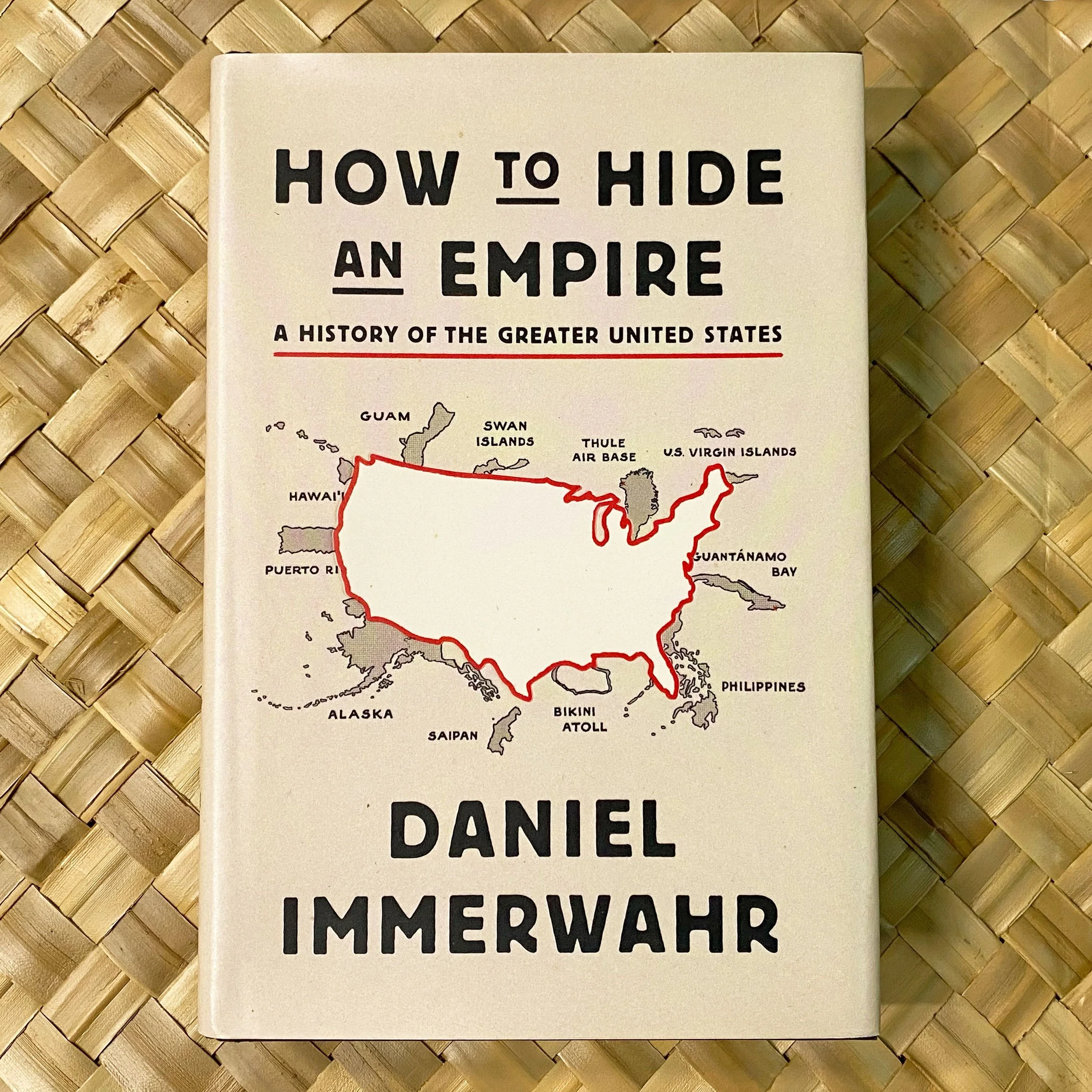
How to Hide an Empire: A History of the Greater United States
by Daniel Immerwahr, 2019. Nonfiction, 516 pages.
“We are familiar with maps that outline all fifty states. And we are also familiar with the idea that the United States is an ‘empire,’ exercising power around the world. But what about the actual territories—the islands, atolls, and archipelagoes—this country has taken and governed?
In How to Hide an Empire, Daniel Immerwahr reveals that overseas possessions, while frequently neglected, have played an essential role in America’s story—enabling its rise, testing its ideals, and serving as laboratories and launching pads for critical and sometimes harmful innovations. In crackling, fast-paced prose, he travels to the guano islands, where prospectors planted the flag atop mounds of nitrogen-rich bird droppings, and Puerto Rico, where a distinguished physician conducted grisly experiments that helped provoke independence fighters to later shoot up the US Congress. In the Philippines, we witness the construction of a dazzling fantasy city high in the mountains in the early 1900s and the destruction of Manila, the sixth-largest city in the United States, in 1945. All told, the Second World War in the Philippines was the bloodiest event ever to take place on US soil.”